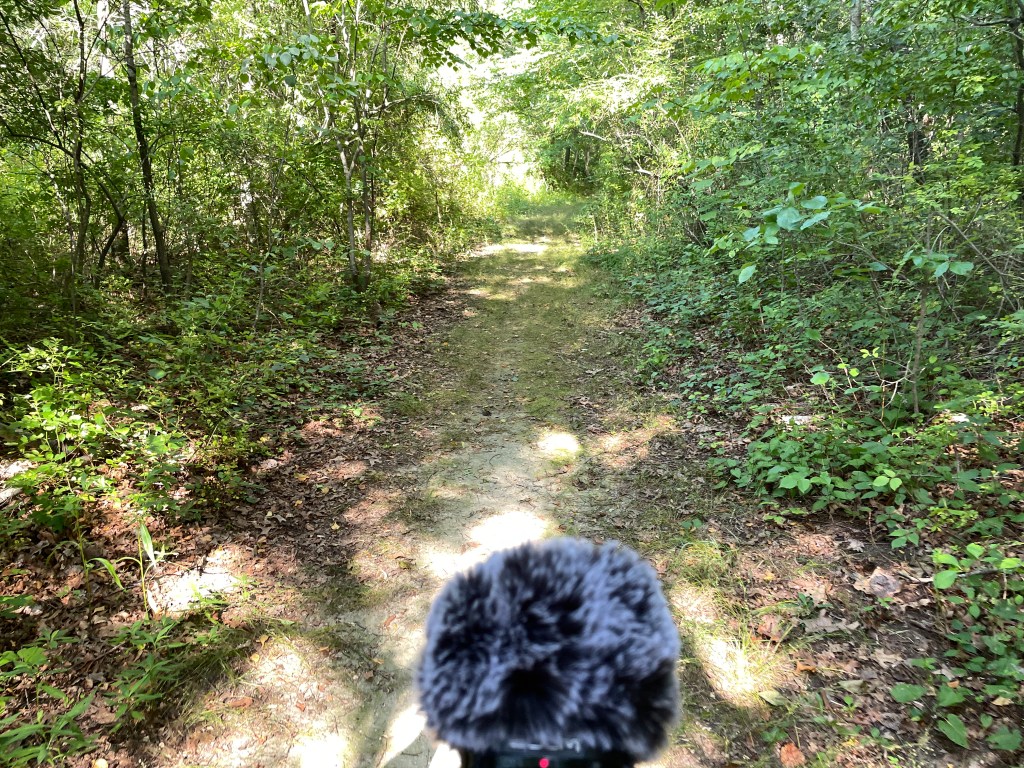
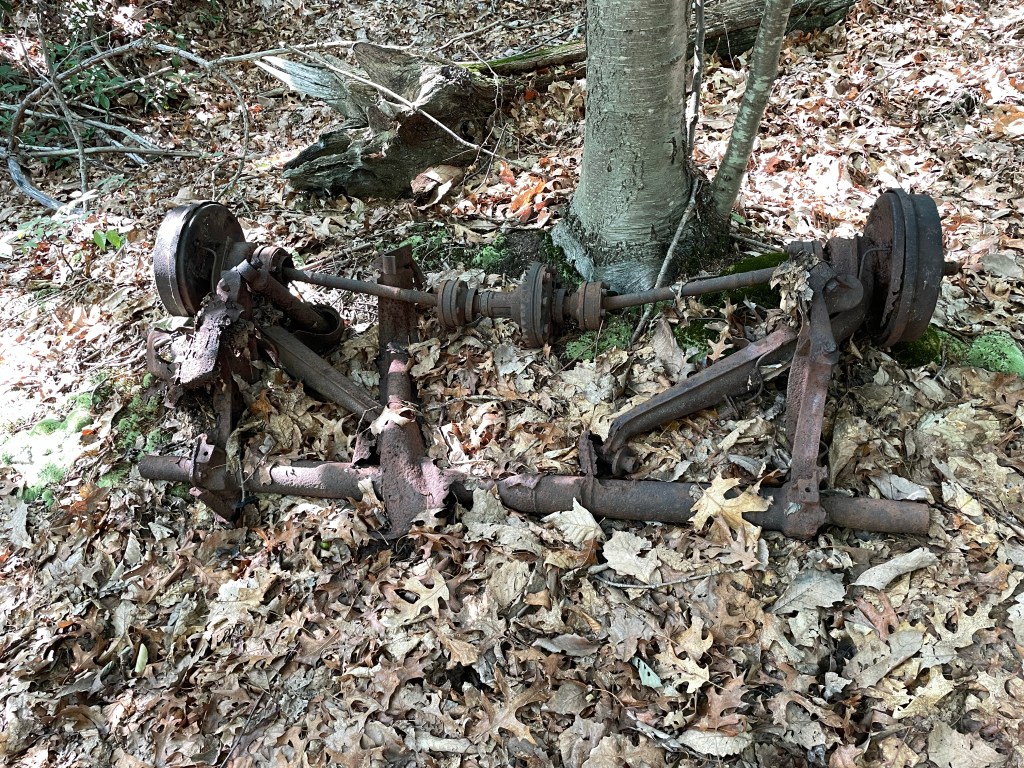
During summer 2024 I stayed in a house at the edge of the woods. Halfway up the driveway a path cuts through the trees and into a circular clearing and then down into a wooded ravine. This project was an experiment in recording the sounds of the woods at night, from the dusk chorus of birds and insects through the late night, when total darkness meant I need to keep my recorder in one hand and a flashlight in the other.
One of the interesting things about field recording is the way it isolates the sonic dimension of the space. Actually being in the woods at night can put you on high alert, mainly because of the darkness, the difficulty in finding one’s way, and—one thing that does carry into the sound recordings—the variety of unexpected and unplaceable sounds, such as the crunching of last year’s dead leaves underfoot—the sound of which can change suddenly depending on the composition of the forest floor (plant litter, sticks, dead leaves over duff, the decaying under-layer) and on what falls out of the trees to hit the ground beside you.
That said, listening back to these recordings I found that the difference between dusk and deep night, for example, was clearly audible especially in the style and intensity of insect noise. The selections presented here include a range of times of night, and proximity to the road or deeper woods; represent dog walks, solo walks, and mundane errands (trash night, for example, involved rolling a wheeled garbage can along the edge of the woods and up to the road); and surprising sounds that caught me unaware, punctuating natural sounds with fireworks, trains, low flying planes, and electronic interference among other things.
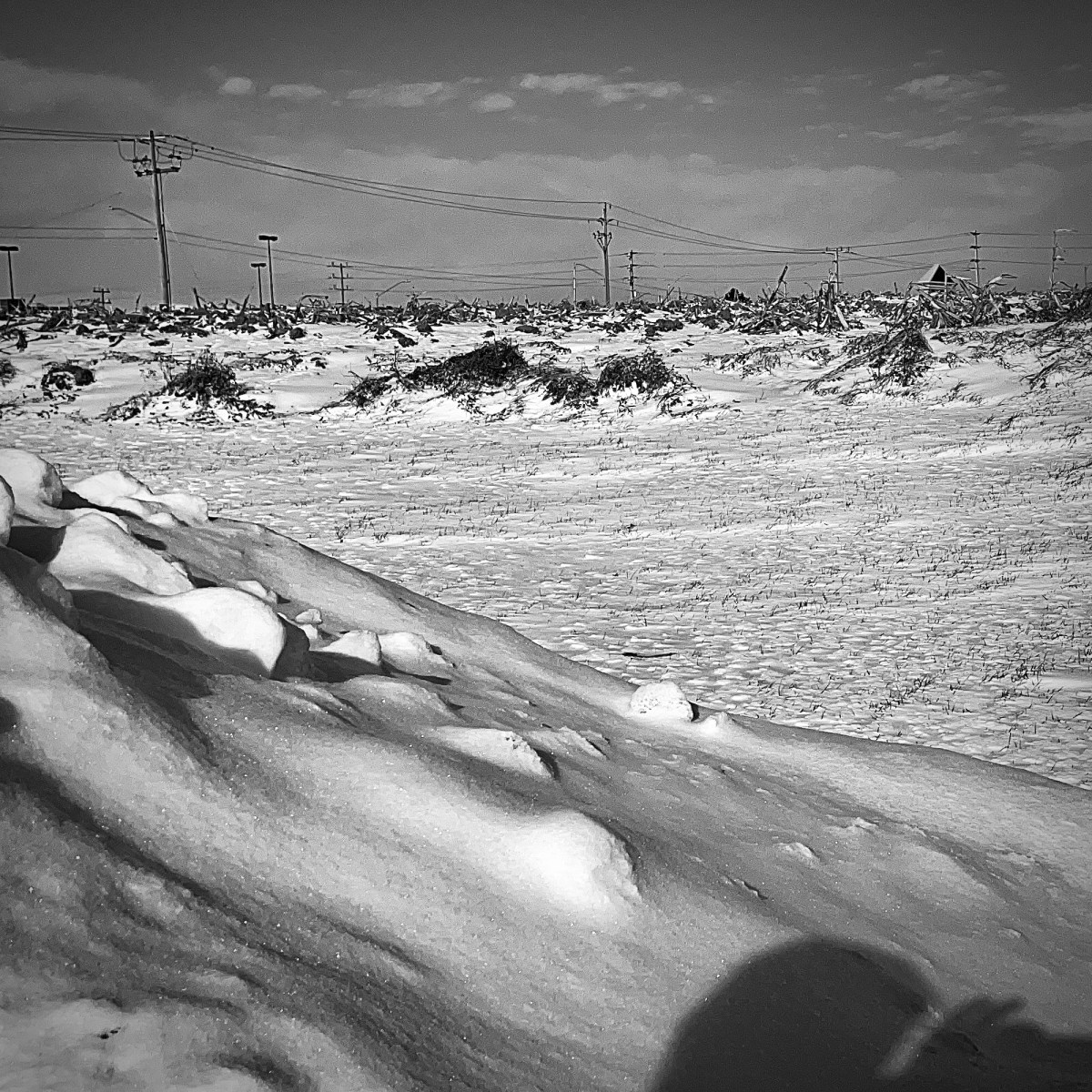
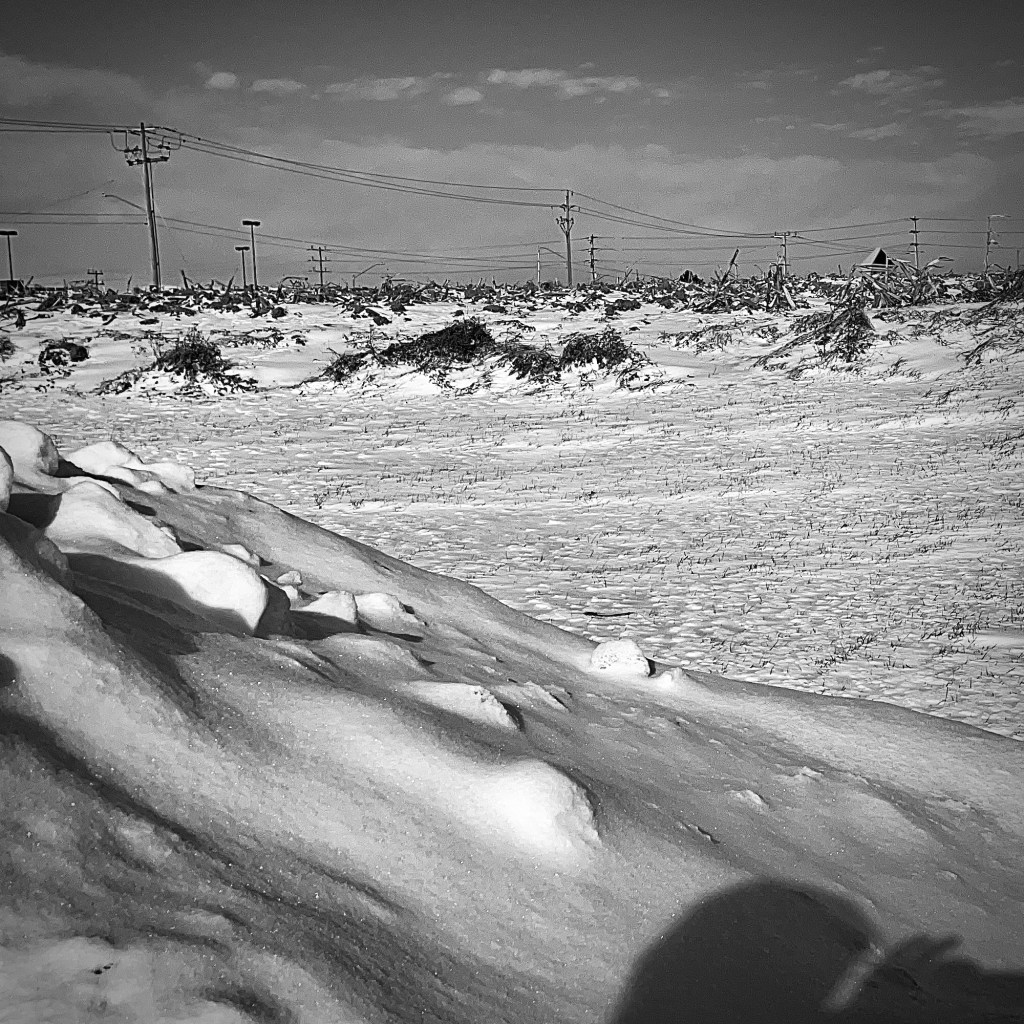
For our first release of 2024 we have a set of Winter field recordings from Canada, recorded in January 2023 and rediscovered a year later, as the first deep freeze of 2024 set in. There are three main recordings, each presented first naturally and next as its uncanny double.
This set of soundwalks is the first in a series of visits to haunted sites, considered both in light of their histories in urban legend and as mundane, ordinary places. Think of it as found footage horror, but where nothing horrific, or even out of the ordinary, needs to happen. We have some more in mind and invite you to submit yours.
The first featured location, “Mount Misery,” is a frequent entry in lists of New York’s most haunted sites. It also features prominently in John Keel’s Mothman Prophecies (1975), where it is described as “the highest point on Long Island,” a haunted and “heavily wooded hill” that became a hotspot of paranormal activity. Claims about this area range widely, from legends about cursed land sales and haunted hospitals to UFO sightings, red-eyed cryptids, and haunted houses, woods, and intersections.
But, as I found upon arrival, there is no place actually called “Mount Misery,” and certainly no hill with that name. References to such a place are usually pointing to a roughly triangular patch of what is now West Hills County Park. This hot zone is flanked by Mount Misery Road to the southwest and Sweet Hollow Road to the southeast, and capped to the northeast by Jayne’s Hill, which is indeed the highest point on Long Island. Most writers seem to be using the more suggestive name “Mount Misery” either for that hill, or for the whole general area. (For a deep dive on the region’s history and its misrepresentations in paranormal literature see Atteberry.)
These recordings comprise two soundwalks and three recordings taken in the car. The walks are presented without processing, as natural soundwalks in the method described by Hildegard Westerkamp. The drives, on the other hand, have some unnatural effects processing. Westerkamp suggests that “When going for a walk is replaced by going for a drive […] our contact with nature becomes purely visual,” seen through the windshield. But the experience of the road while driving is also ubiquitous in urban legends and in reports of hauntings and paranormal encounters. Taken together, these two types of field recording—natural walks and uncanny drives—convey those very different components of Mount Misery, the haunted woods and the haunted roads.
The first track is a walk up the modest, wooded incline to the peak of Jayne’s Hill, with the sounds of doves; dry leaves and gravel underfoot; insects; distant aircraft; and a pause at the summit, which is the purported site of many UFO experiences but is currently more noteworthy for the large boulder that bears a plaque with Walt Whitman’s “Paumanok” lines from Leaves of Grass.
Track 2 is the drive from Jayne’s Hill to Mount Misery Road and up that road as far as it is driveable, stopping at the edge of the woods at a spot with trail access.
Track 3 is a longer soundwalk through the woods adjacent to Mount Misery Road. These are the sounds of getting briefly lost in the woods, from dirt and gravel paths near the road out into deeper underbrush and cracking twigs; and with light traffic noise increasingly overtaken by waves of insect noise, then returning to the sounds of passing cars as I found my way back to Mount Misery Road.
Track 4 is a drive on Sweet Hollow Road, under what is supposed to be a haunted overpass beneath the Northern Parkway. Local legends allege this to have been the site of various macabre events, and some versions add a version of the “ghost propulsion” motif also found, for example, at many of the sites dubbed “Gravity Hill”— that if you put your car in neutral, it will continue forward, pushed or pulled through the overpass by the ghosts that haunt this stretch of road.
Track 5 is my departure from the area, from a parking lot just north of the haunted overpass back down to Old Country Road. This is a route that also features in Mount Misery’s stories. In Mothman Prophecies, John Keel’s informant and men-in-black contactee “Jane” was checking out the commotion in the opposite end of the West Hills with her boyfriend when they witnessed a paralyzing flash of light from the sky; “The next thing they knew, they were driving along Old Country Road at the base of Mount Misery.”
In November 2022 a group of researchers from the University of Waterloo undertook a soundwalk in connection with their study of “atmosphere” in gothic literature and media. In addition to the general goal of introducing the theory and practice of soundwalking, their specific goal was to explore the underground network of tunnels that connect many of the campus’s buildings. An artifact of the campus’s heating systems, and once a forbidden zone and the subject of urban myths and clandestine adventures, in more recent decades they have become a more mundane part of the campus, an insider’s tip for how to avoid walking outside during cold winters.
The walk began in a classroom, proceeded out an exterior door past construction and honking geese; and then entered the nearest building that had an access stairway to the tunnel system. After descending and passing through the tunnel, the group returned to ground level through a nearby building. From there they split up and took separate paths back, one of which passed by one more site of machine noise—tree removal along Laurel Creek, on the west side of the campus.
The first track presents a reimagined version of the whole walk, processing the recording in ways that linger over some of its gothic resonances: the way that “uncanny sounds from the outside followed us into the interior spaces;” and the way mechanical sounds overpower natural sounds.
The next few tracks focus on particular phases of the walk. Tracks 2 and 3 form a pair that studies the relation between sound and noise. This pairing presents the tunnel audio, and especially the echoes of footsteps, in two ways: first with a focus on echo and doubling (with the whole piece heard simultaneously forward and in reverse); and then, in Track 3, submerged in additional layers of noise.
Track 4 stops to linger over one particular tunnel sound—the rumble of a heating vent—and juxtaposes it with other moments of audible airflow, such as the depressurization that comes with the opening of a door. In the COVID-19 era, thinking about the air on campus has taken on a newly uncanny dimension.
Track 4 scores a scene of tree removal, with a musical composition for synth and wood chipper. The final track presents the original, untreated recording from one of the soundwalk’s pathways.
The next few tracks focus on particular phases of the walk. Tracks 2 and 3 form a pair that studies the relation between sound and noise. This pairing presents the tunnel audio, and especially the echoes of footsteps, in two ways: first with a focus on echo and doubling (with the whole piece heard simultaneously forward and in reverse); and then, in Track 3, submerged in additional layers of noise. Track 4 stops to linger over one particular tunnel sound—the rumble of a heating vent—and juxtaposes it with other moments of audible airflow, such as the depressurization that comes with the opening of a door. In the COVID-19 era, thinking about the air on campus has taken on a newly uncanny dimension. Track 4 scores a scene of tree removal, with a musical composition for synth and wood chipper. The final track presents the original, untreated recording from one of the soundwalk’s pathways.
Image credit: adapted from a photograph of the University of Waterloo underground tunnel, by Victor Vucicevich, licensed under CC-BY-SA-3.0 creativecommons.org/licenses/by-sa/3.0/deed.en
Our second release for March 2023 features a new entry in the Ecogothic/Ecoacoustic series, built around a field recording by guest contributor Lisa Brackenridge.
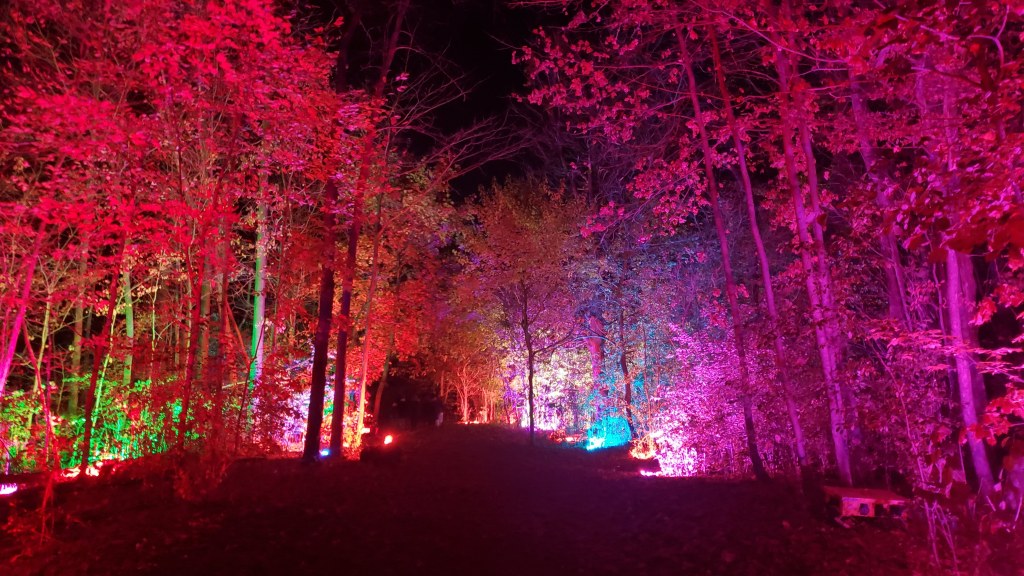
The first piece takes us on an eerie, time-stretched walk through a city park during an October 2022 augmented reality event. Brackenridge writes: “This track works with sounds recorded at a placemaking event in Kitchener, Ontario called Enchanted Forest: a one-kilometer trail loop illuminated with light displays, art, and sound effects. I imagine the creators of the installation had the goal of augmenting the landscape to make it somewhat magical. However, “enchanted” can also mean being bewitched; and although bird sounds are common in that space, hearing prerecorded birdsong at night was uncanny. By slowing down the sound by only thirty per cent, I was able to further augment the perception of the landscape: the slowed-down sounds change the sounds of an enchanted space to that of a haunted or eerie space.”
Enchanted Forest installation; photos by Lisa Brackenridge
Track 2 is a Gothic Listening remix that slows the birdsong further, and blends it with some original field recordings of tropical birds. This walk in the park was already a little bit unsettling, even before slowing it down, because of the way that natural sounds blended with prerecorded birdsong. The more it slows down, the more that uncanniness comes to the surface, like ghostly voices you can hear in the forest if you listen closely.
This week sees the first of two releases we have planned for March 2023. This first one, from guest contributor Christopher Rogers, is an eerie piece of audio documenting the sounds of ordinary domestic spaces.
This piece, framed as a soundtrack to a dismal, atmospheric photograph, works right at the intersection of two ongoing GL projects: it focuses on the everyday and the ordinary at the same time that it brings out the “ecogothic’ dimensions of those ordinary living spaces (their insides, their outsides, and the passages between them).
About the project, Rogers writes:
“This recording attempts to soundtrack a photo taken on a foggy day in a backyard in Waterloo, Ontario, when the weather gave the usually vibrant space a feeling of eeriness and abandonment.
“The audio experiments with blurring the boundaries of human and natural spaces by reimagining an everyday activity – going outside – through an ecogothic lens. Interior or human space is signaled initially with the drone of a furnace followed by a sliding door. The recording then transitions to the backyard space where bird songs and road noise are layered to create a sense of liveliness. A familiar sliding door sound signals a return indoors, where a turntable can be heard skipping. Time stretching and reverb are added throughout the recording to emphasize the strangeness of these everyday sounds.”
This month’s piece is an unprocessed field recording capturing the sounds of the recent wind storm, on December 23, 2022, as an arctic front created a sudden chill throughout much of central and eastern North America. While there were devastating blizzards and snowfall not too far away, at this recording site, a house at the edge of the woods, the main effect was an extreme cold, and high winds that (in the recording) can be heard loudly in the winter-bare trees and wind chimes.
Listen to it attentively or inattentively; treat it as an ambient background for meditative reflection or for your everyday business; or sample it for your own purposes, musical or otherwise.
This is the third entry in the Ecogothic/Ecoacoustic series, an ongoing project that invites recordists and sound artists to listen to the sounds of gothic nature in field recordings and/or remixed and reimagined sounds. If you have recordings of your own to share, or if you want to use these mostly raw recordings as the basis for your own remixed and reimagined sounds, visit our submission guidelines to read about how to get involved, and check out our open, ongoing projects. Gothic Listening invites both original submissions and reimaginings or remixes of any of the project’s existing creative-commons-licensed sounds.
We’ve just released the second entry in the Ecogothic/Ecoacoustic series, an ongoing project that invites recordists and sound artists to listen to the sounds of gothic nature in field recordings and/or remixed and reimagined sounds.
This entry in the series pairs recordings from two sessions listening to birds of prey. These were recorded in the same location, a wooded area in Suffolk County, New York, with a large raptor population. The first track is a mostly untreated field recording consisting of ten minutes of rain, hooting owls, and a distant train. The second is a shorter loop of birdsong punctuated by the cry of a Cooper’s hawk. That clip is played forward, then in reverse, then in both directions at once.
If you have recordings of your own to share, or if you want to use these mostly raw recordings as the basis for your own remixed and reimagined sounds, visit our submission guidelines to read about how to get involved, and check out our open, ongoing projects. Gothic Listening invites both original submissions and reimaginings or remixes of any of the project’s existing creative-commons-licensed sounds.
“Okay, Bob (Echo)” is the first entry in the “Unvoiced” project, an ongoing series that invites artists to reimagine the non-verbal sounds of gothic and horror film and television, whether by remixing public domain materials or by using foley art and other techniques to think through, recreate, or reimagine the nonverbal sound track.
This first entry in the series was released on the occasion of the academic conference “Beyond Life and Death: Twin Peaks at Thirty.” The first portion recreates the nonverbal and ambient sounds from a scene in the Twin Peaks pilot episode (aired April 8, 1990), from timestamp 52:42-53:42. The second part samples that recreation and remixes it into a drone track.
In this scene Audrey sits on a desk, twisting a pencil into a styrofoam coffee cup; pulls it out to let the coffee spill over the paperwork on the desk, and then walks off loudly toward the conference room to cause similarly impish disruption with the Norwegian investors assembled there.
At that point, this track transitions into a drone built from samples of that recreated and “unvoiced” scene, processed using techniques that feature prominently in the sonic world of Twin Peaks itself–namely time-stretching and reverse processing.
The scene itself was chosen for its foregrounding of the obtrusive sound of the pencil twisting into styrofoam, but the process also led to an unexpected discovery. Audrey’s remark to the hotel employee – “Okay Bob – Okay Bob – Okay” – is palindromic, and seems meant as an eerie foreshadowing of revelations that will come about regarding the more sinister entity of that name, and of his affiliations with the preternatural world of the Black Lodge and its reverse-processed speech. However, playing this phrase backwards revealed an extra layer as “Okay Bob – okay Bob – Okay” became “Echo – Bob Echo – Bob Echo.”
Materials: styrofoam, water, paper, shoes, chair, bird, electric piano.
Greg Hainge, “When Is a Door Not a Door? Transmedia to the Nth Degree in David Lynch’s Multiverse.” In Transmedia Directors: Artistry, Industry and New Audiovisual Aesthetics, edited by Carol Vernallis, Holly Rogers, and Lisa Perrott, 271–84. Bloomsbury, 2020.
Alice Kuzniar, “Double Talk in Twin Peaks.” In Full of Secrets: Critical Approaches to Twin Peaks, edited by David Lavery, 120–29. Wayne State University Press, 1995.
John McGrath, “On (Vari-)Speed across David Lynch’s Work.” In Transmedia Directors: Artistry, Industry and New Audiovisual Aesthetics, edited by Carol Vernallis, Holly Rogers, and Lisa Perrott, 285–90. Bloomsbury, 2020.
Holly Rogers, “The Audiovisual Eerie: Transmediating Thresholds in the Work of David Lynch.” In Transmedia Directors: Artistry, Industry and New Audiovisual Aesthetics, edited by Carol Vernallis, Holly Rogers, and Lisa Perrott, 241–70. Bloomsbury, 2020.







 The Gothic Listening Project